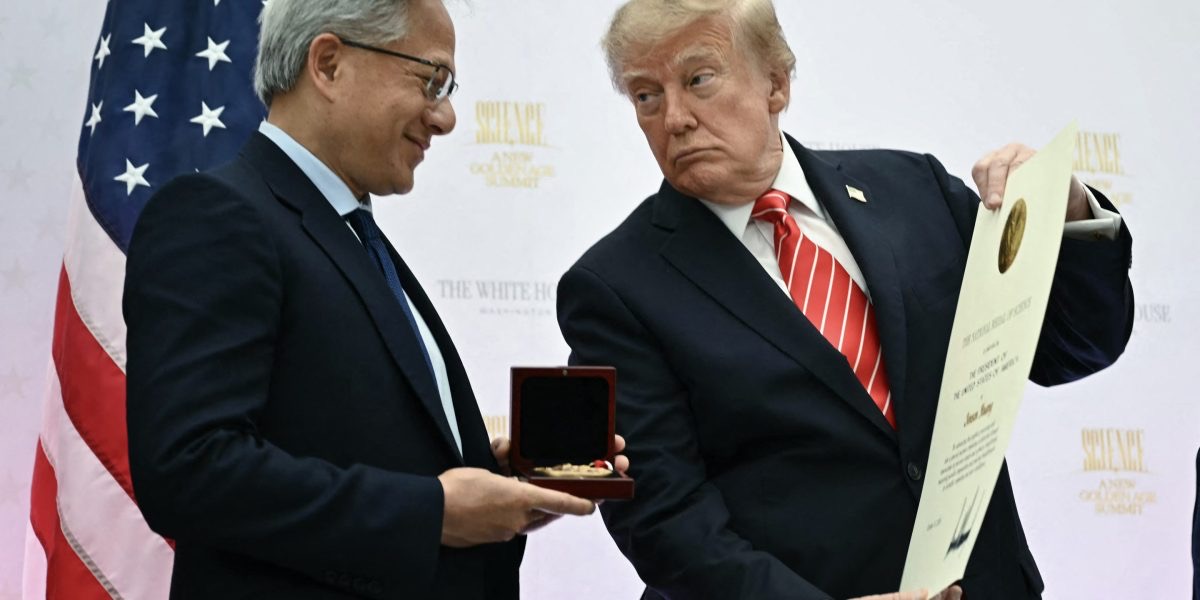
The numbers come first. Jensen Huang stepped down as Nvidia's CEO after revelations of his affairs with a suspected Chinese spy and at least one Nvidia employee. The company's board chair said at the time that it did not intend to reinstate him, and Huang remained without an employer for 11 days. Then the White House intervened.
According to the Wall Street Journal, President Donald Trump, Vice President JD Vance and other senior officials spent the weekend lobbying on Huang's behalf. By Monday, Nvidia's board unanimously voted to reinstate him as CEO. "I spoke to them, let me put it that way," Trump told CNBC in a phone call. "And I convinced them."
Trump told the Journal that Nvidia's falling share price helped his case. He said he assured the board that his administration would not punish the company for possible violations of export controls or securities laws if it rehired Huang. The Securities and Exchange Commission (SEC) is currently probing the company. The New York Times reported that Trump was briefed in 2025 on Huang's relationship with the woman and on intelligence that she was passing information to Beijing, and chose not to act.
This is not an isolated episode. The administration has bought stakes in companies, obtained veto rights over business decisions and negotiated terms for chip sales to China, which has been designated a matter of national security. Since January 2025 it has announced 49 investments worth $30.8 billion, according to the Council on Foreign Relations' Government Deal Tracker. White House spokesperson Matthew Middleton told Fortune the investments focus on 'securing and reshoring America's critical supply chains.'
The pattern extends across the chip sector. The administration negotiated a deal approving Nvidia's chip exports to China in exchange for 15% of the revenue, and in December let the company sell its more powerful H200 chips to China for a 25% cut. Last year Trump called for Intel CEO Lip-Bu Tan to resign over alleged conflicts of interest with China, then reversed course after meeting him. Weeks later the government took a 10% stake in Intel. It also obtained veto rights over certain decisions at U.S. Steel as part of approving its $14.1 billion sale to Nippon Steel.
The president also has a personal financial interest. Trump's investment accounts bought between $152,004 and $380,000 worth of Nvidia stock in September, two months before Huang's resignation, according to financial disclosures released by the Office of Government Ethics on Nov. 19. Nvidia shares closed more than 30% higher the day the board reinstated Huang. The Trump Organization has said the accounts are run by independent managers with no input from the president, and the White House told Fortune that 'neither the President nor his family has ever engaged—or will ever engage—in conflicts of interest.'
The market has already voted on the outcome, at least for now. Nvidia's rally shows investors value Huang's leadership, which analyst Jeffrey Towson described as making him 'almost a national asset.' But the lesson for the boardroom is less comfortable. Patrick Boyle, a former hedge fund manager and visiting finance professor, told Fortune that boards of strategically important companies are concluding they should check with the White House before making major decisions.
That is the real cost. Capital rewards clear rules, and one of America's great economic advantages has been that its companies answer to their shareholders, not to whoever holds the phone at the White House. When a board reverses a decision after a presidential call, and the president holds the stock, the rule of law and free enterprise both look weaker. Taxpayers, who are shareholders in every sense that matters, deserve rules that apply to the powerful and the connected alike.