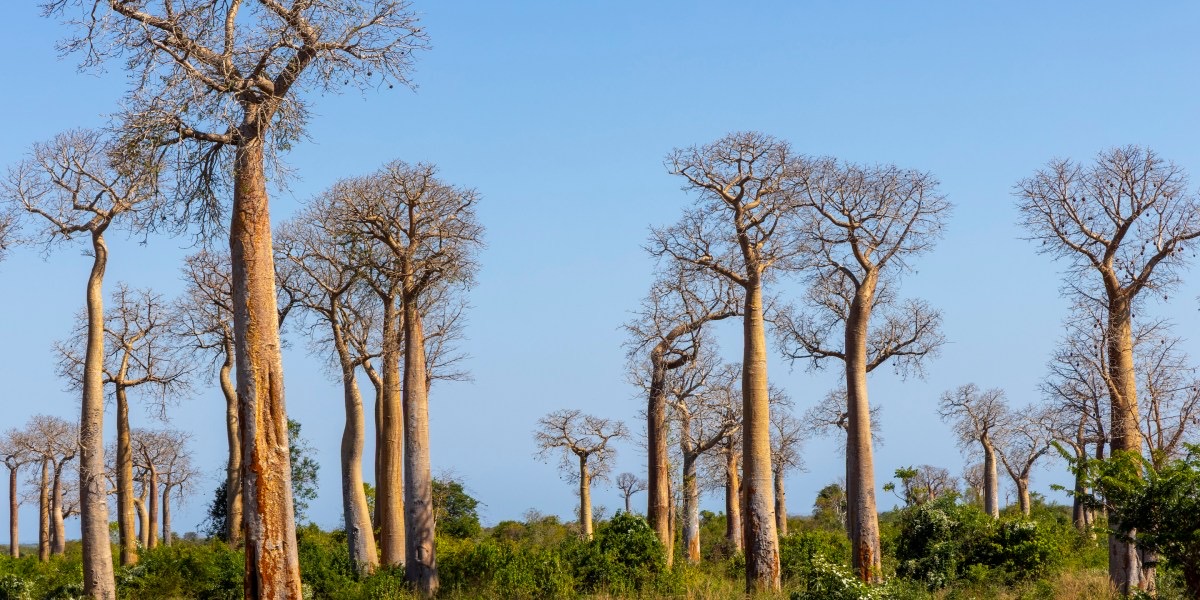
For more than three months, five baobab trees lay on their sides in a Durban warehouse parking lot. Their roots and branches had been hacked back. They were waiting to be shipped to Georgia.
South Africa's Department of Forestry, Fisheries and the Environment (DFFE) intercepted the trees on July 17. The exporter, Pretoria-based Divine Landscapes, could not produce licenses to remove, transport, or export them. Every baobab in South Africa is a specially protected species under the National Forests Act. The law bars anyone from cutting, disturbing, removing, transporting, or exporting one without a license.
The DFFE says the trees were dug up in the Lephalale area of Limpopo province without a provincial permit. It refused the company's late license application at the end of July. It dismissed the company's appeal on October 27. The company denies wrongdoing. Its attorneys told Daily Maverick the trees were 'obtained from private gardens with the full consent of the respective owners,' and said it is seeking judicial review. The company's owner appeared in Durban Magistrates' Court in September, and the case was postponed to January.
Officials have not named the buyer. However, reporting by Daily Maverick traced the trail to the Shekvetili Dendrological Park. It is a private arboretum on Georgia's coast, founded by billionaire Bidzina Ivanishvili, the country's former prime minister and the founder of its ruling Georgian Dream party. According to Daily Maverick, Ivanishvili has not commented, and requests to his lawyer and to Georgia's embassy in Pretoria went unanswered.
The park's record is a cautionary tale. Eight baobabs uprooted on Kenya's Kilifi coast were bound for the park when Kenyan President William Ruto halted their export and ordered an investigation. The Kenya Forest Service later authorized the shipment, and the trees reached Georgia in 2023. All eight died. In August 2024, the park confirmed the deaths and blamed delays it attributed to Ivanishvili's political opponents.
Dr. Sarah Venter, an ecologist and founder of the Baobab Foundation, said South Africa did not want 'a repeat of what happened in Kenya.'
The seizure also left authorities with a practical problem. Seized cargo can usually wait in storage. These trees could not. Journalist Tony Carnie described them as lying in full sun, with no water and no soil. Venter warned that the trees were using stored stem water to survive, and a healthy baobab can be up to 75% water. The rescue was privately funded. The Timbavati Private Nature Reserve offered to cover loading, transport, and replanting. On November 11, the trees, each estimated at 17 to 30 tons, began a roughly 900-kilometer trip to the reserve on abnormal-load trucks.
The case also points to a wider trend. On October 23, parties to the United Nations Convention against Transnational Organized Crime voted 83 to 12, with 27 abstentions, to begin negotiating a protocol on environmental crimes. South Africa co-sponsored it. DFFE Minister David Maynier said, in a ministry statement, that 'environmental crime is organized crime.'
The market has already drawn the lesson. Rare living assets carry value that buyers will pay for, and that value attracts trade whether or not the paperwork exists. Property rights in nature only work when licenses are clear, enforced and applied to everyone, including a wealthy collector with a private park. The taxpayer in South Africa now pays for the courts, the storage and the rescue effort. The cost of a permit system that was ignored shows up in public budgets and in dead trees.
The lesson for investors and owners is simple. Clear rules protect value. Where the rules are fuzzy or enforced selectively, the costs fall on the public and the asset itself.