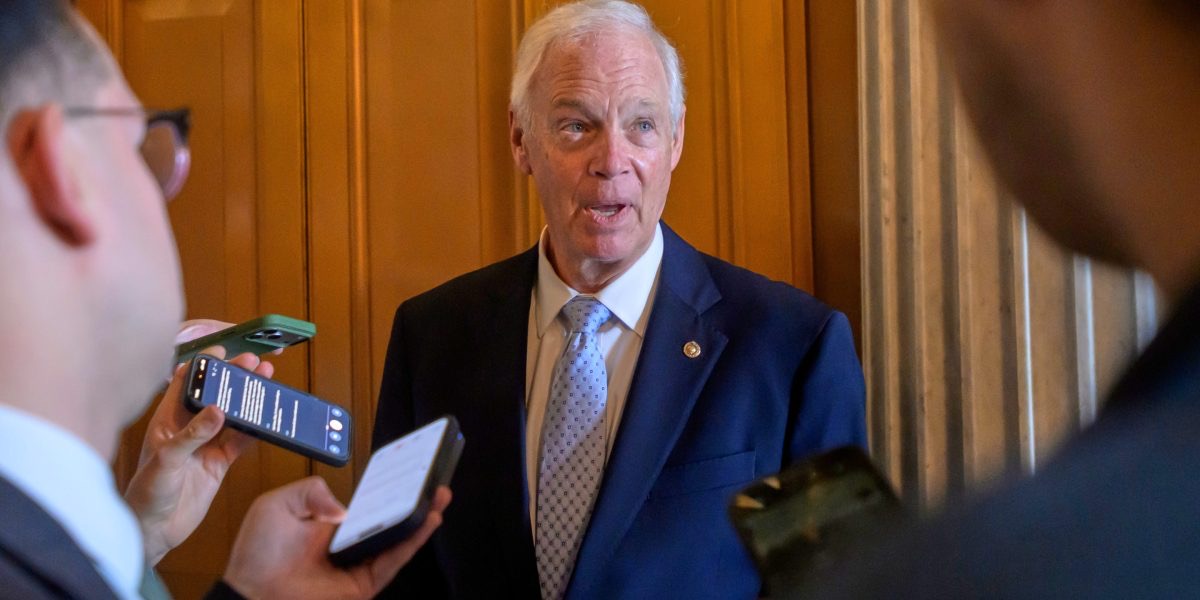
Social Security's retirement trust fund is less than six years from running dry. When it does, benefits are cut automatically by about 22%. Senate Budget Committee Chairman Ron Johnson, a Wisconsin Republican, has a plan to prevent that cut: let the Treasury borrow the difference.
On November 18, Johnson put forward a proposal that the Committee for a Responsible Federal Budget (CRFB) calls the Stop Scaring Seniors Act. It would allow the Treasury Secretary to move money from the government's general fund into the retirement trust fund once its reserves are gone, so beneficiaries would keep receiving full checks. CRFB estimates the measure would add $190 trillion to the national debt over 75 years in inflation-adjusted terms, equal to 165% of GDP.
For the roughly 70 million people collecting benefits, the cut it would avoid is real money: about $500 a month for the average beneficiary, according to CRFB. The harder question is who pays instead. Social Security has been funded through payroll taxes since the 1930s, and by law it can pay only what its trust fund holds. Johnson's plan would remove that limit and send the bill to the Treasury, which already borrows to cover deficits.
CRFB, a nonpartisan deficit-hawk group, argues the near-term danger is worse than the distant one. CRFB president Maya MacGuineas called the bill 'a cynical pander that ducks all the real decisions we need to confront.' She warned that 'even simply passing the legislation could spook the bond market enough to spark financial turmoil,' and said the borrowing 'would almost certainly spark a crisis.' The group has modeled a similar approach before. In an analysis from last November, it estimated that funding Social Security from general revenue would push interest rates up about 2.6 percentage points, lifting the 10-year Treasury yield from 4% to 6.6% and 30-year mortgage rates from 6.3% to 8.9%.
Johnson's argument is that Americans have been misled about how the program is financed. A Senate Budget Committee report he released the same day, titled 'Social Security: The Reality… a Legal Ponzi Scheme,' projects a shortfall of about $511 billion by 2032. 'Your money was spent to pay current beneficiaries or fund other government programs,' Johnson said, according to the National News Desk, and future benefits will be paid with money from 'your sons and daughters working at that time,' plus borrowing. MacGuineas agreed with part of his point. She called his position that Congress should fix the overall deficit rather than carve out Social Security 'a reasonable position,' but said a law that 'fails to fix Social Security while ballooning the debt' is not the way to get there.
The timing adds pressure. TD Securities expects the current $41.1 trillion debt ceiling to start binding in January, with the government running out of room around September 2027, roughly five years before the trust fund is exhausted. Johnson's bill would place Social Security on that same borrowed money.
The market has already priced in how expensive borrowing becomes when Washington stops controlling its own commitments. Capital rewards clear rules, and a benefit program that can only spend what it has is the clearest rule the system offers. Replacing that rule with an open-ended transfer from the general fund does not eliminate the cut; it moves the cost onto the taxpayer, into higher Treasury yields, and onto the mortgages working families depend on. Seniors deserve a solvent system, not a promise paid for with the next generation's money. The honest fix is the one Johnson himself gestures toward: reform the program and the deficit together, in the open, with the trade-offs named.