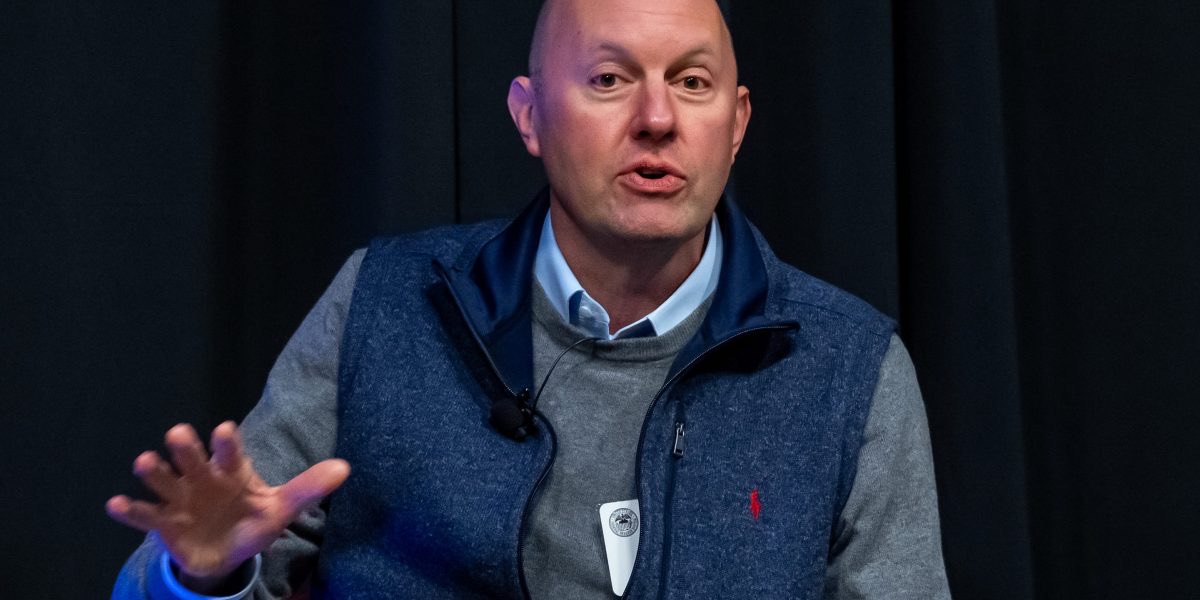
Marc Andreessen got the last word at the Federal Reserve's big AI conference in San Francisco on Monday, and he used it to tell the central bank that nearly everyone in the room was going to be disappointed.
"My line has been both utopians and the doomers are going to be disappointed," the venture capitalist said, "specifically disappointed by the scope and magnitude of the real-world impact, and specifically the economic impact."
Andreessen co-leads the Productivity and Jobs Task Force, which Fed Chairman Kevin Warsh set up to assess what super intelligence, which the White House prefers to call "SI," will do to growth, prices and jobs. The group is advisory, and Andreessen has no vote on interest rates. He co-leads it with Stanford economist Charles Jones and Microsoft executive Asha Sharma. The panels are due to report to the rate-setting committee by year-end, though Warsh said in October that "some, but not all" would deliver on time. The Fed's task force page lists no ethics or recusal terms for the panels. Andreessen's firm, Andreessen Horowitz, raised more than $15 billion in new funds in January, as venture firms raced to keep up with the AI boom.
Andreessen previewed his contribution by invoking William Baumol's "cost disease," the reason flat-screen TVs get cheaper every year while hospital bills, tuition and rent move the other way. His argument is that AI will not cure that disease and could make it worse.
He splits the economy in two. The "fast sectors," including consumer electronics, media and commodity goods, adopt new technology quickly, and "what those sectors all have in common is they have rapidly falling prices." The "slow sectors" (health care, education, housing, and law and government) "are not legally allowed to have rapid change, like literally not."
"The machine cannot get an MD, cannot prescribe medication," he said. "The machine cannot get admitted to the bar."
In his telling, the slow sectors pair restricted supply with subsidized demand. You cannot easily build new housing or open new hospitals, and when voters revolt over the cost, Washington steps in with student loans and housing subsidies. "So, of course, prices can only go up."
He then followed the logic to its end. As prices fall in the fast sectors, those sectors shrink as a share of GDP, and the slow sectors take over. Health care, he said, "is already a fifth of US GDP and I don't see why it doesn't go to a fourth, a third and then half and then ultimately 80%." The government's count is 18% in 2024, or $5.3 trillion, according to CMS actuaries.
"You might interpret this as good news because it means the AI revolution is not going to destroy all the jobs or kill everybody," he said. "You could also view this as very negative, which is productivity growth just simply may not grow very much. Economic growth just simply may not grow very much. We may just continue to stagnate."
Warsh opened the day with three illustrative scenarios Fed staff have begun to evaluate: AI lifts productivity with broadly shared gains; growth runs above its long-term average but automation pushes unemployment higher; or AI disappoints after heavy capital investment and stock market gains, and the economy eventually recovers "without the productivity gains." Andreessen's version is duller. Most of the economy simply does not let the technology in.
The market has already priced the boom. The question is whether the rules will let the returns reach the economy. If health care, education and housing stay under legal lock, AI becomes a tool for the sectors that were already cheap, while the costs that squeeze the household keep climbing. For the taxpayer, that means more subsidies chasing the same scarce supply. For the entrepreneur, it means a market that only opens where the regulators allow it.
Capital rewards clear rules. Andreessen's warning is that the Fed is now weighing AI's economic future through a lens shaped by the sectors most protected from competition. Free enterprise would let the machine take the MD exam and the bar exam. Until then, the productivity boom the utopians promised may stay trapped behind the licensing board.



