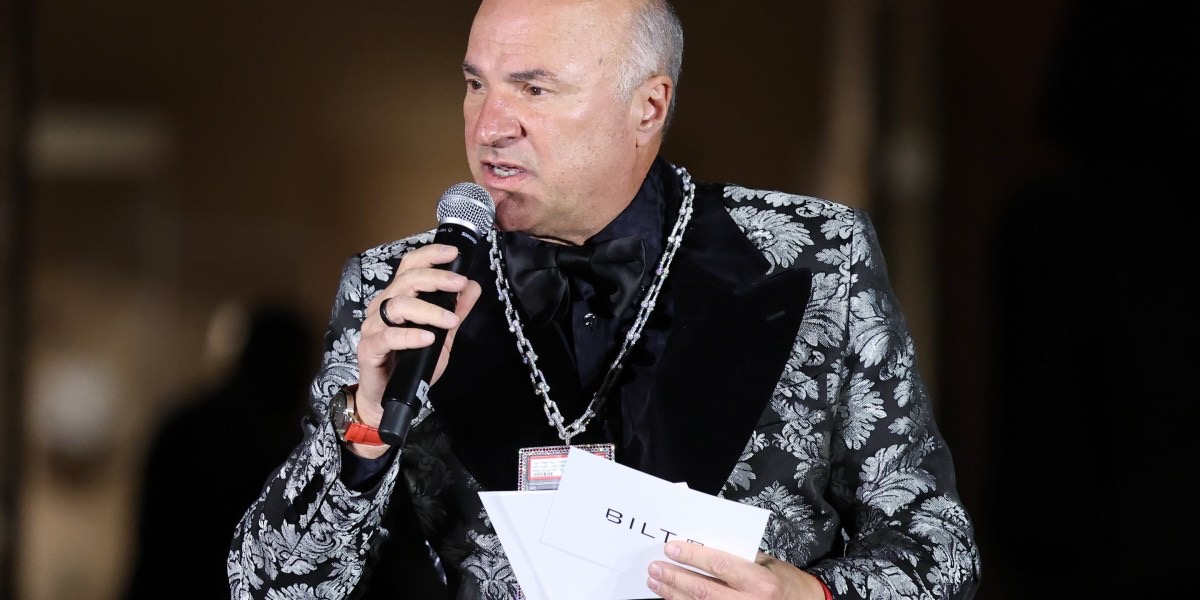
The pitch is an old one on Wall Street: spend less, save 15% of every paycheck, and let the gains compound in the stock market. Shark Tank investor Kevin O'Leary repeated it during a Jubilee Media-hosted debate with 20 Gen Z workers. The episode, titled '1 Millionaire Boss vs 20 Gen Z Workers,' posted November 15, and the 8-minute exchange over profit sharing became one of the flashpoints of the nearly two-hour session.
The challenge came from a software engineer named Joe, who asked why the money workers earn through their labor should go to people like O'Leary. 'We did the work,' he said. He opened with a Starbucks hypothetical: why shouldn't some of the chain's profits go to the workers making and serving the coffee? Starbucks reported $37.9 billion in revenue for the fiscal year that ended Sept. 27, and recently raised its dividend. Joe pointed to those dividend payments as proof that the company already distributes profits, and argued that workers deserve a larger share of them.
The debate then turned to Amazon, which this year unseated Walmart as No. 1 on the 2026 Fortune 500. Joe argued that pay splits sharply by role. A software engineer may receive substantial restricted stock units, while a warehouse employee with equal effort may receive no equity stake. O'Leary answered that the labor market sets compensation: if Amazon could not find enough warehouse workers, it would have to pay more to attract them. He also said equity cannot work in every industry. 'You can't do that in every business. You can't give equity to a utility,' he said.
Joe countered that equity is not the only tool. Dividends and profit-sharing plans can also give employees a direct stake in their employer's success. He cited Mark Cuban, who has given employees equity at companies he founded and has urged every CEO to do the same. The two found common ground on SpaceX, where rank-and-file employees became millionaires after the company's June IPO, which was expected to make more than 4,400 current and former employees wealthy. O'Leary said he was fine with that outcome.
Joe's larger point was that windfalls like SpaceX are the exception. O'Leary bristled at the idea that investors simply get rich off other people's labor. 'I worked pretty damn hard to get rich. Really hard,' he said. Asked what investors contribute beyond money, he answered bluntly: 'Money.'
Rather than wait for companies to share profits, O'Leary urged workers to put 15% of their earnings into the stock market, a recommendation he has repeatedly made to younger Americans.
The market has already answered the question that Joe raised. Capital is the scarce input that funds payroll, inventory and expansion before a single dollar of revenue arrives, and investors are paid for taking that risk. Wages are set by what employers must pay to attract workers, and equity is a tool that suits some businesses far better than others. Profit sharing and employee stock can work, and firms that adopt them do so voluntarily, which is the point of free enterprise. The alternative, a mandated split of profits set by debate or by regulation, would weaken the incentive to invest in the first place. For a young worker, the more durable path is the one O'Leary described: own a piece of the capital, rather than waiting for someone else to hand it over.