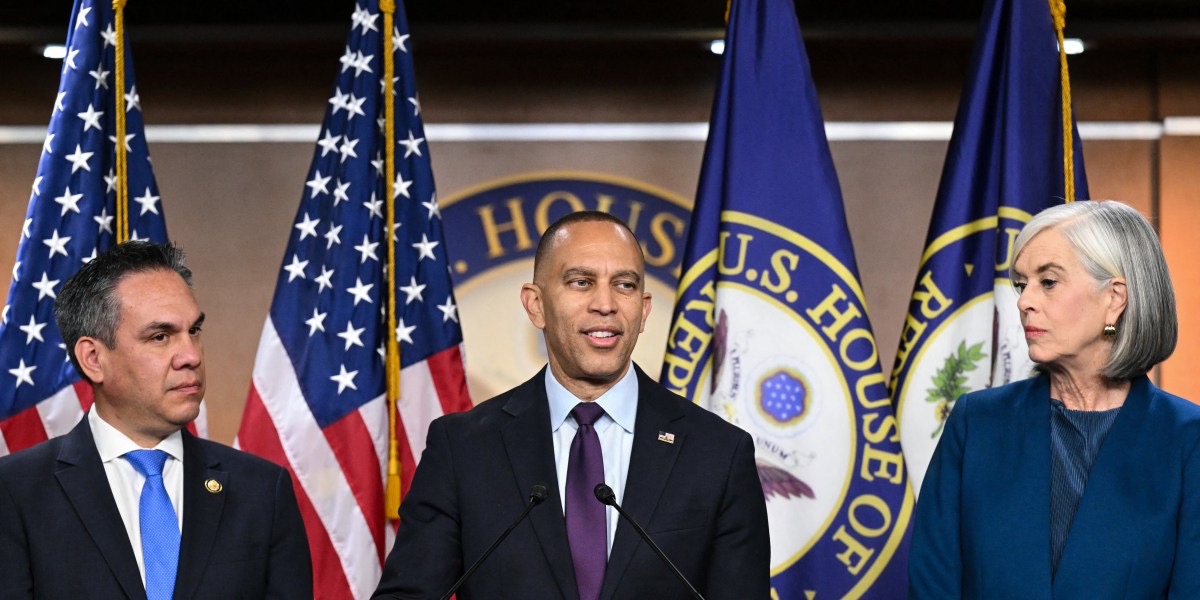
The numbers come first. Democrats are heading into the 120th Congress with slim majorities in both chambers, and they have been clear about their priorities. House Minority Leader Hakeem Jeffries, nominated by Democrats to be Speaker of the House, wrote in November that the first 100-day agenda includes 'reverse the Medicaid cuts, restore SNAP funding, extend the Affordable Care Act tax credits, eradicate the Trump tariffs, and stop the reckless war of choice in Iran.'
The Committee for a Responsible Federal Budget (CRFB) has tallied what that agenda would cost. In total, the 'First 100 Days' policies would cost $4.1 trillion through 2037. Without offsets, meaning spending cuts or revenue increases used to balance new policies, $4.9 trillion would be added to the debt burden over the next decade, including interest costs.
The largest single hole comes from tariffs. Removing the Trump tariffs accounts for $1.8 trillion in total over 2027 to 2037, including $955 billion from repealing Section 301 tariffs, $780 billion from Section 232 tariffs, and $35 billion from undoing Section 338 tariffs on certain Canadian goods. Fortune notes that tariff revenue reached $287 billion in customs duties, taxes, and fees in 2025, according to the Richmond Fed, up 192% from the prior year. Reversing the health provisions of the One Big Beautiful Bill Act (OBBBA) would cost $1.6 trillion by 2037, including $600 billion to cancel provider tax and state-directed payment limits and $485 billion to remove Medicaid work requirements. Reversing the SNAP provisions would cost $250 billion over ten years. Higher deficits would also mean roughly $840 billion in additional interest payments over the next decade.
The savings side is modest. According to the CRFB, continuing the war in Iran costs approximately $30 billion a year, and ending it would avoid those military and defense outlays, though it would not immediately shrink the deficit.
The debt-to-GDP ratio is the figure budget hawks watch most closely. It stands at around 121%, per the Federal Reserve Bank of St. Louis, and the CRFB projects it would rise to 135% by 2037 without offsets, compared with 125% under an adjusted CBO baseline. Economists warn that once that balance tips far enough, lenders may demand higher premiums to cover the risk, which could trigger a bond crisis.
The watchdog also lays out how the spending could be paid for. Repealing the OBBBA tax cuts for high earners would generate about $2 trillion, enough to fund an agenda scaled back by half. Repealing all of the OBBBA tax cuts and spending increases, including the low-income and middle-class cuts, would raise about $7 trillion, according to the CRFB, or 1.7 times the cost of the agenda. Those options are unlikely to be popular with voters, which is the political problem in the plan.
The market has already started asking the question that matters: who pays? Every dollar of new borrowing is a claim on future taxpayers, and every tax increase is a dollar that does not go to hiring, capital investment or household budgets. Capital rewards clear rules and predictable costs, and a $4.1 trillion agenda with no identified funding is neither.