The numbers come first. The Greater Bay Area, or GBA, spans nine mainland cities in Guangdong province plus Hong Kong and Macau, and it holds 88 million people. With a GDP of $2.1 trillion, its economy approaches Canada's in size. That scale is real, and it is the reason Beijing has pursued the project for roughly a decade.
The results are less convincing in one place that officials chose to showcase. As recently as 2009, Hengqin, an island in Zhuhai just across from Macau, was home to oyster farmers and fishermen. Authorities hoped it would have 280,000 residents by 2020. By the end of 2025, it had just 50,000. The island, three times Macau's size, now has multilane highways, striking architecture and manicured parks, but the people have not followed the concrete.
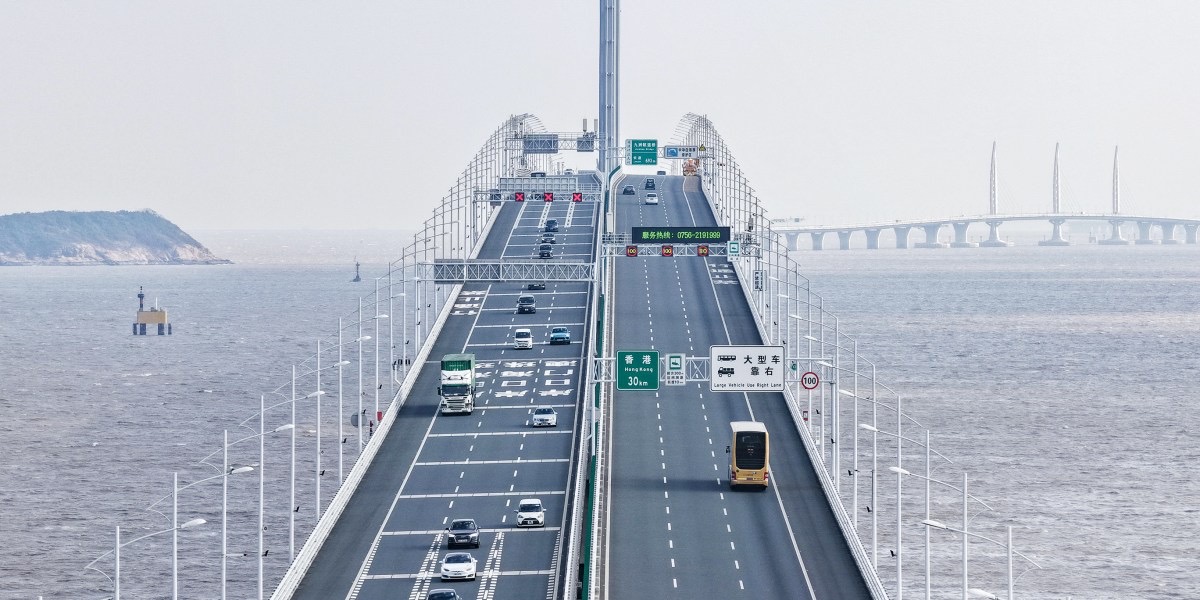
That gap is the lesson for anyone who prices capital in this region. Infrastructure built on a planning target does not create demand on its own schedule. The Hong Kong-Zhuhai-Macau Bridge, the world's longest bridge-and-tunnel sea crossing at an estimated cost of $20 billion, is a clear example of capital committed ahead of the market. Hundreds of kilometers of railway were built with the same logic, aimed at a 'one-hour living circle' that would foster collaboration.
The innovation record is more encouraging. The Global Innovation Index, published by the World Intellectual Property Organization, ranked Shenzhen-Hong Kong-Guangzhou as the world's leading innovation cluster in both 2025 and 2026. According to state media, the GBA's nine mainland cities filed more than a third of China's international patent applications in 2025, and the region accounts for a fifth of the country's unicorn startups. Those figures reflect something the planners did not fully engineer: the Hong Kong financial sector pairing with Shenzhen's hardware and software founders, supported by the manufacturing base of Dongguan and Foshan.
Alicia Garcia-Herrero, chief economist for Asia-Pacific at Natixis, put the original ambition plainly: 'The original idea was to compete with the [U.S.] Bay Area.' Mehran Gul, author of The New Geography of Innovation, drew the central contrast. 'The U.S. Bay Area is more organic,' he said. 'It almost happened by accident.' In the GBA, by his account, 'the division of labor has been central to making it happen.' That is a description of coordination from above, and it is the core of the bet.
The market has already voted on parts of this plan. Shenzhen's founders built companies because the rules rewarded risk-taking, and the cluster's patent and unicorn numbers reflect that private energy. Hengqin's empty streets reflect a different allocation: public money and land directed toward a target that households and businesses did not choose.
Capital rewards clear rules. Three legal systems, three currencies and three customs territories are not a clean platform for investors, and the question of whether the other cities can join Hong Kong and Shenzhen remains open. The right lesson is not that integration is impossible, but that growth which comes from market demand is durable, while growth ordered by a plan on a timetable is not. Taxpayers, in China as elsewhere, should be wary of any project that asks them to build the future before anyone has chosen to live in it.



