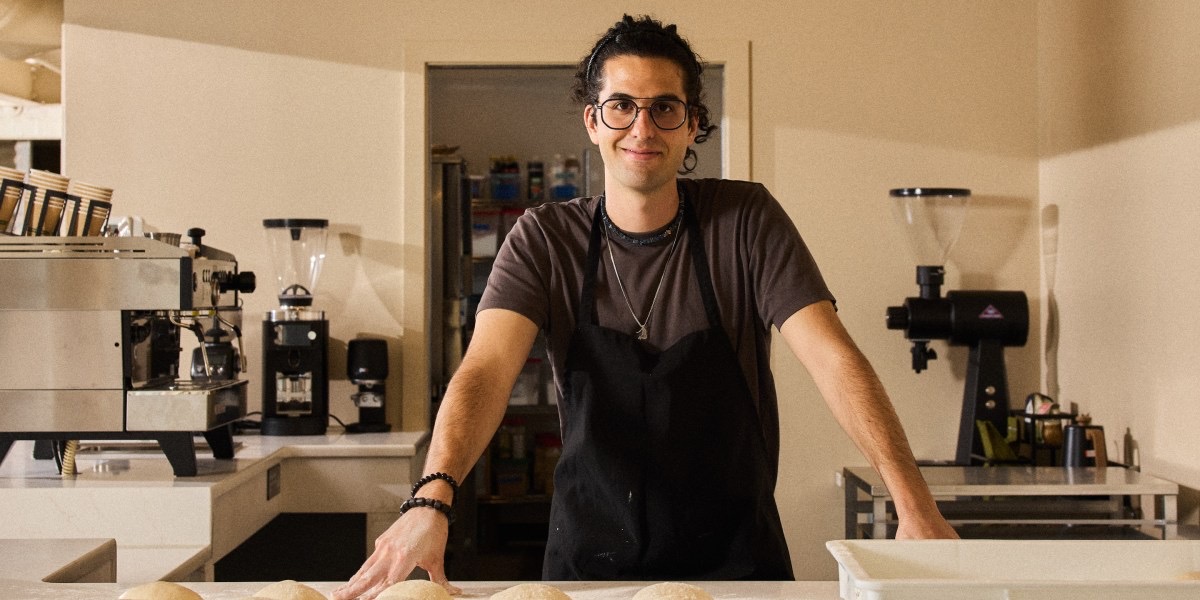
Saif Manna started selling cookies from his college apartment kitchen, mixing every batch by hand because he didn't have a stand mixer. Five years later, the 27-year-old runs Manna Bakery, a Philadelphia bakery-café with around 20 employees.
The business now brings in about $120,000 a month, Manna told Fortune, and he projects $1.8 million in revenue in its first year with a permanent storefront.
The growth did not come from a large advertising budget or a polished social media strategy. It came from meeting customers face to face, building relationships with other small businesses, and expanding production without taking on costs he could not afford.
That discipline carried into the storefront. In a business where 'every dollar counts,' as Manna puts it, he opened for a little over $100,000 after passing on spaces that would have required a buildout of $300,000 or more.
The relationships began running in his direction. 'So I was no longer asking them, now they were asking me to come,' Manna said, recalling the moment local cafés started inviting him to sell his pastries.
Manna officially launched in March 2021 while studying political science at Temple University. He set up a table in his apartment building lobby or somewhere on campus and sold cookies to students. 'To be honest, at that point, I really wasn't thinking of permits,' he said. 'I was just, you know, a young college student just trying to do what I love.'
His building, home to roughly 200 residents, let him sell in the lobby. Word spread to neighboring buildings, and he began taking orders through Google Forms for pickup downstairs.
Early on, Manna was making less than $2 in profit per baked good. He deliberately kept prices in line with other local bakeries rather than charging a premium or cutting ingredients to widen his margins.
A turning point came when a customer suggested he take his pop-ups beyond campus. One recommended café, Herman's Coffee, was known for hosting pop-up vendors. Manna tracked down the owner and secured a date, and café owners who saw the lines began inviting him through Instagram. The arrangement paid off for them as well, since customers who came for pastries often bought coffee.
By 2023, farmers' markets were inviting him in. Some had waiting lists stretching for years, Manna said, but demand helped him secure a spot, first at a small market in Germantown and then at larger ones across the city. 'We became part of people's weekly or weekend habits,' he said.
At one market he was selling 800 to 1,000 pastries in just three hours. In 2026, Philadelphia magazine named his extra-brown-butter chocolate chunk cookie the best cookie in the city.
The Manna model reflects something basic about free enterprise: a business that keeps its fixed costs low and its prices honest can scale on customer demand alone. He did not borrow heavily to start, he refused a buildout that would have sunk his margins, and he let sales finance the next step. Capital rewards discipline, and a $100,000 storefront that generates six-figure monthly revenue is a far better use of money than a $300,000 build-out that depends on hope.
The lesson also cuts against the bloated cost structures that choke so many small operators. Manna's apartment kitchen could only stretch so far, and his answer was to find existing capacity rather than wait for a subsidy or a bank loan. That is the market at work: a young entrepreneur, a willing café owner and a paying customer, with no committee in between.