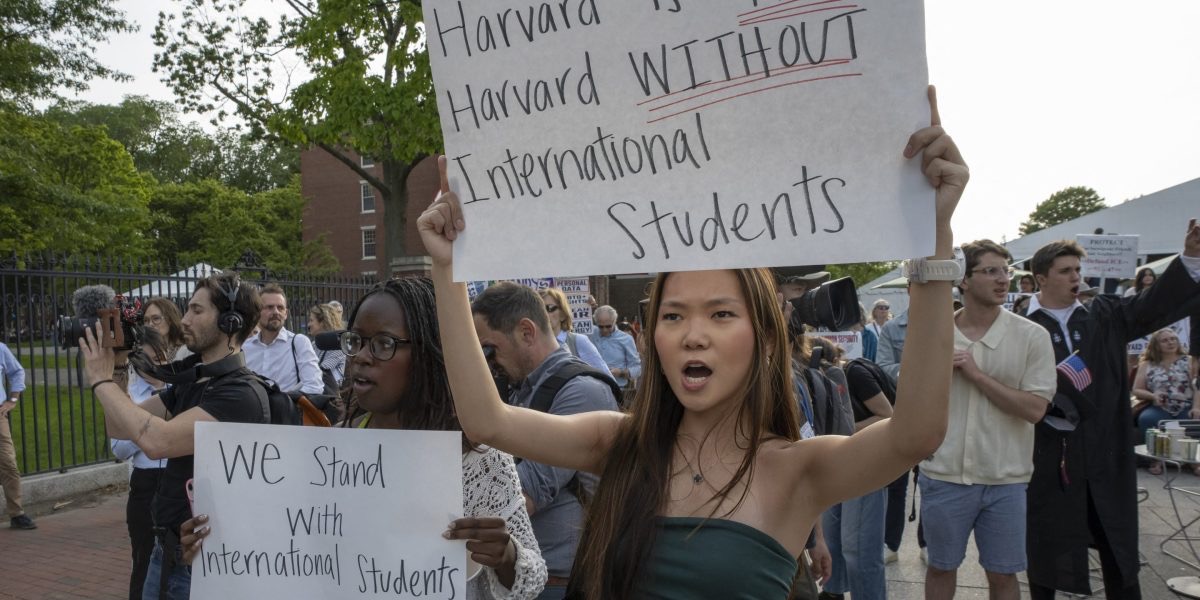
The numbers come first. New international students at U.S. colleges fell 18% in the 2025–26 school year, to 228,123, according to the Institute of International Education, which released its annual Open Doors report on Monday. The first look at this fall points to a second straight drop: in IIE's fall 2026 snapshot of more than 800 schools, new international enrollment fell another 15%.
The headline total looks calmer, at 1,146,163 international students, down 3%. But that count includes 335,785 graduates on Optional Practical Training, a program that lets them work in the U.S. after their degree and pays no tuition. That group rose 14%. Strip it out and the number of international students enrolled in classes fell about 8%, a figure IIE confirmed to Fortune. That is roughly 73,000 fewer students paying tuition.
The policy path is documented. In May 2025 the State Department paused student visa interviews, then restarted them with expanded social media vetting. A travel ban that began with 19 countries grew to 39, plus the Palestinian territory, on January 1. In July, the Department of Homeland Security finalized a rule replacing open-ended student status with a fixed four-year limit. A federal judge in Massachusetts blocked that rule in September. Among schools reporting declines this fall, 88% blamed the visa application process and 70% blamed travel restrictions, according to IIE's snapshot.
The losses were concentrated in graduate programs. Graduate students fell 13% to 423,078, and master's students fell 22%. Indian graduate students, the largest group, fell 34%. Doctoral students rose 3%, and undergraduates slipped 0.3%. Moody's found in 2025 that a 15% drop in international tuition would barely touch operating margins at 77% of the universities it rates. But about 15% of rated universities have more than 15% international students, and under a 20% drop, Moody's said, 15 universities could lose 2 to 8 points of operating margin.
The dollar figures are estimates, not reported losses, since colleges do not disclose how much tuition they lost. University of North Texas President Harrison Keller has said each admitted master's student who did not enroll would have brought his school between $20,000 and $25,000. Multiplying the roughly 73,000 missing students by that range yields about $1.5 billion to $1.8 billion in lost tuition, which is a floor because private schools charge international students far more. NAFSA, the trade group for international educators, puts the cost of this fall's decline at another $2.4 billion and 31,000 jobs, based on surveys.
The money hurts more than the headcount suggests. Princeton research cited by the Hechinger Report found international students made up 6% of enrollment but 12% of college revenue. They usually pay close to full price and receive little aid.
The market has already voted. Schools are not simply losing a line item; they are discovering that a visa process built around suspicion is a price signal, and prospective students are reading it clearly. Competing countries are courting the same students, and the rising cost of a U.S. degree compounds the problem. Capital rewards clear rules, and a student weighing a multi-year commitment wants predictability that the current system does not offer.
For the American taxpayer, the question is who absorbs the damage. Public universities depend on tuition from full-paying foreign students to offset state budgets, and the bill for a shrinking revenue base tends to land on tuition for domestic students or on the public purse. Trump said in August 2025 that without Chinese students, the college system 'would go to hell very quickly.' The enrollment data suggest that the people paying for the policy are the institutions and their local communities, not the officials who wrote the rules.



