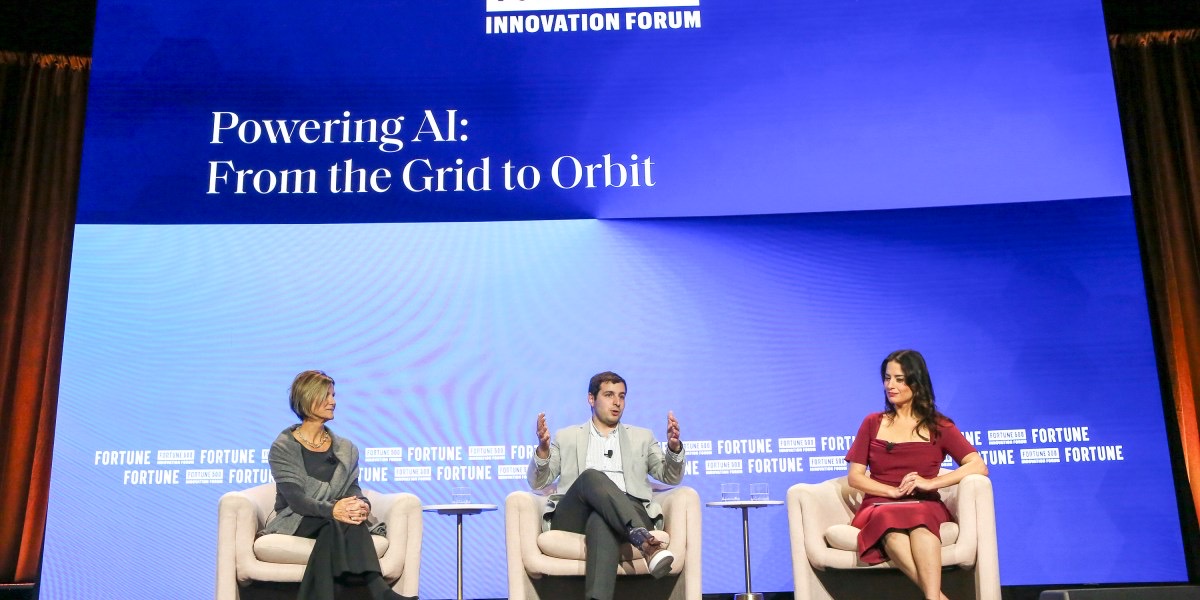
AI has an energy problem, and two solar executives at opposite ends of the industry want the country to start with the infrastructure it already owns.
Abdullah Al-Shakarchi, co-CEO of Overview Energy, made the case at the Fortune 500 Innovation Forum in Detroit. 'We need more generation, that's true, but we already have all these assets on the grid that we're just not taking advantage of,' he said. He noted that gas plants are running at 60 to 70% utilization in some places, and that transmission lines often sit doing nothing.
Mary Powell, chief executive of Sunrun, which installs rooftop solar and home batteries, agreed. Sunrun had about 1.06 million subscribers and 5 gigawatt-hours of networked home battery storage as of Sept. 30, according to its third-quarter results. 'We sit on top of right now gigawatt-hours of energy,' Powell said. 'Some of it's being used by the grid, but I really see the next couple of years as an opportunity to crack that wide open.'
The push for efficiency comes as data-center politics have become impossible to ignore. In this month's midterms, the AI buildout became an affordability issue. Democrat Abdul El-Sayed won Michigan's Senate race arguing that data centers should pay for their own power, and at least 14 Ohio municipalities passed data center bans or restrictions on Election Day.
The household math is already painful. Powell said electric rates have risen 35% in the last five years. Fortune has reported that U.S. electricity prices rose roughly 40% on average over the same period, which makes her figure look conservative.
Overview Energy's proposal is the most ambitious part of the pitch. The company is building satellites that collect sunlight in orbit and beam it down as near-infrared light onto existing utility-scale solar farms, allowing them to keep producing after dark. 'We're creating solar power at night,' Al-Shakarchi said. He argued that if the country built no more utility-scale solar farms by 2030 and simply switched the existing ones on at night, it could power a quarter of national load growth over the next decade. Meta signed an agreement in April for early access to up to 1 gigawatt of that space solar capacity, with an orbital demonstration planned for 2028 and commercial delivery expected by 2030. Al-Shakarchi credited cheaper, reusable rockets for making the economics work: 'That makes us competitive with something like natural gas.'
Asked whether rooftop batteries and space-beamed solar compete, Al-Shakarchi called the relationship 'a great partnership.' Overview could charge solar farms overnight and push that energy over idle transmission lines, topping off home batteries before a storm or an evening peak.
The bottleneck, Powell says, is now regulatory and political. Some parts of the country still do not let home batteries send power back to the grid, and she expects more markets to change that within a year or two. Drawing on two decades at Vermont's Green Mountain Power, much of it as chief executive, she said utility projects take too long. 'It's really gone from NIMBY to BANANA. Build absolutely nothing anywhere near anyone.'
The market has already voted on the principle: use what exists before paying for what doesn't. Every idle gas plant and unused transmission line is capital already sunk, and every rooftop battery that can sell power back is a private asset working for the grid rather than against it. Capital rewards clear rules, and the rules that let storage and existing generation earn their keep are the cheapest route to more power.
The cost of getting this wrong falls on the household. When electricity rates climb 35% to 40% in five years, the taxpayer and the ratepayer absorb the bill for a grid built more than a century ago and slowed by permitting fights. The executives' message is blunt: the fastest megawatt may be the one already sitting on the grid, waiting for a regulator to let it work.



