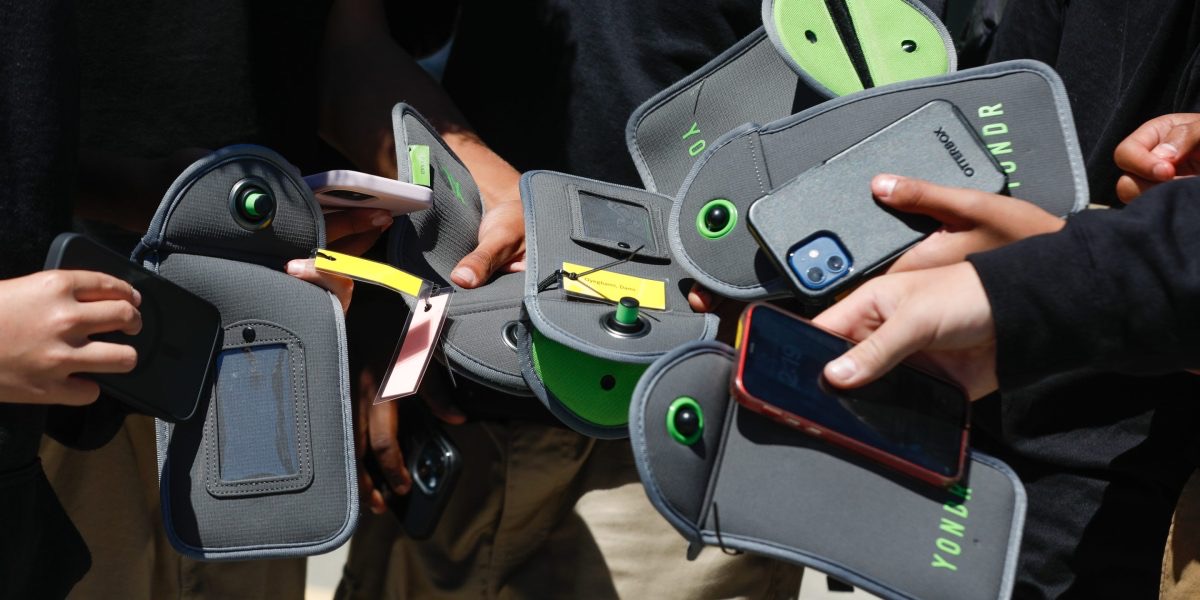
The numbers come first. A national study from Harvard's Center for Education Policy Research, with researchers at Dartmouth and the testing nonprofit NWEA, tracked 3.3 million students at 4,600 schools across 49 states and Washington, D.C., from the 2021–22 through 2025–26 school years. Schools that required students to store their phones in pouches saw an annual boost in achievement growth of 0.01 standard deviations. The researchers translated that into one to two weeks of additional learning per year, or roughly two minutes per hour of class time.
The gains are modest, but the researchers say they persist. Achievement gains began in the first year of the ban and appear to continue three years later. The effect held across elementary, middle and high schools, and across rich and poor ones.
The backdrop is a decline that predates the pandemic. Tom Kane, an economist and education professor who directs Harvard's Center for Education Policy Research, released an Education Scorecard tracing what he calls a 'learning recession' back to 2013. Between 2013 and 2024, eighth-grade math and reading achievement fell by roughly one grade equivalent. The slide lines up with the spread of smartphones: in 2011, fewer than a quarter of teen students had access to them, and by 2018, 95% did. 'Strict cell phone bans seem to plug about half of that leak,' Kane said in a statement.
Kane was also candid about the rest of the problem. According to Kane, 'the two main suspects are declining test-based accountability following the replacement of the No Child Left Behind Act and out-of-school social media use.' He acknowledged that one major question remains unexplained: the steep drop among the lowest-achieving students.
The evidence is contested. A National Bureau of Economic Research study released in May found that strict bans had close to zero effect on test scores. Tom Dee, a Stanford professor and co-author of that study, told NPR he considers the early results on phone bans 'largely disappointing.' Neither study has yet been published in a peer-reviewed journal, and the two measured different things. The Harvard study is also not a randomized trial. Kane said it compared growth at roughly 800 Yondr-adopting schools before and after adoption against 3,800 matched comparison schools, and that similar pre-adoption trends made the team more confident. The researchers themselves warned that state-level results in 22 states could reflect pre-existing trends.
For districts, the pitch is about cost. Kane puts the price of a pouch at about $25 per student and argues that this is 'a small price to pay for an additional 1-2 weeks of instruction per student.' New York and 16 other states put bell-to-bell bans in place last school year, so the spending decision is already being made across much of the country. Advocates such as Ashwin Verghese, communications director at the children's advocacy nonprofit Fairplay, say the findings match what schools have seen, citing changes in culture and more face-to-face interaction in classrooms and cafeterias.
The editorial takeaway is straightforward. Taxpayer dollars are finite, and every line item in a school budget should answer for its results. A $25 device that buys weeks of instruction is the kind of low-cost, measurable intervention free-enterprise logic favors, and it is more persuasive than another round of spending with no measured return. But the study's own authors concede that the evidence is preliminary and not yet peer-reviewed. Districts should treat the pouch as a cheap experiment worth continuing, not as proof that the broader learning slide has been solved. Accountability and the question of what drives the decline among the lowest performers still deserve the hardest scrutiny.



