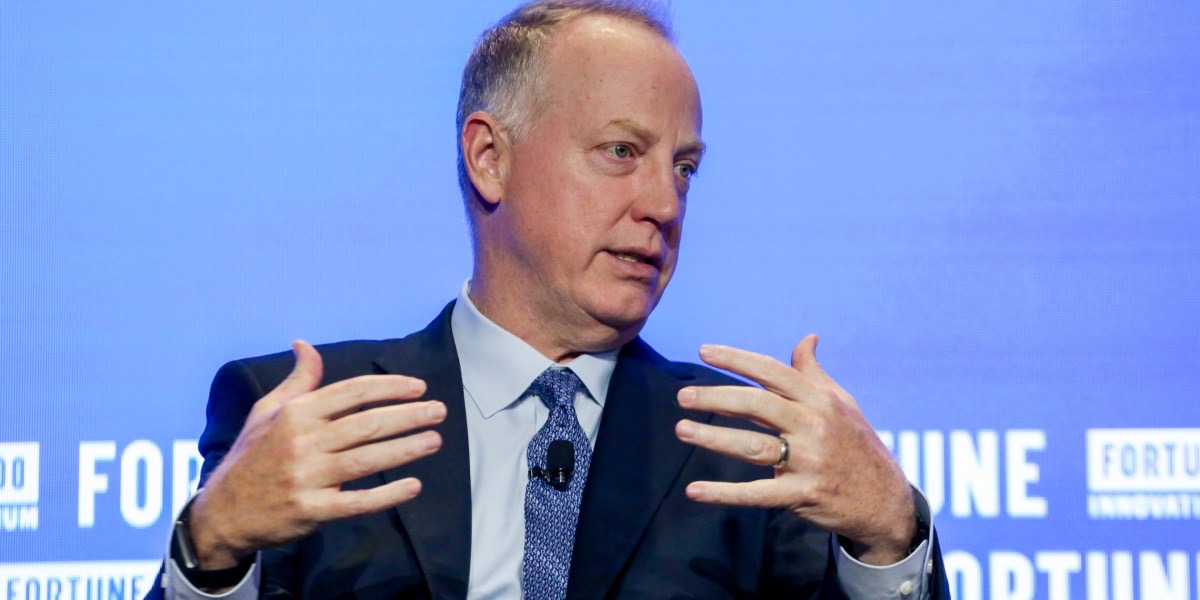
Patrick Conway, CEO of Optum, still works weekends as a hospital pediatrician in Boston. He described what he sees there in blunt terms. "That should not happen in America, but it does every single day," he said.
He recounted three recent patients. One was a 14-year-old girl who had called more than 100 people trying to get mental health care before she ended up in his hospital with broken legs. Another was a 21-year-old with meningitis who worried she could not afford the bill. The third was a 15-year-old on Medicaid who needed complex rehab for a neurologic disorder, and the hospital struggled to find anywhere to send her.
During the week, Conway runs Optum, the health services arm of UnitedHealth Group. He said Optum employs about 300,000 of the conglomerate's roughly 400,000 people. Speaking at the Fortune 500 Innovation Forum in Detroit, he told Fortune's Diane Brady that the weekend shifts are the point. "Those stories could be anywhere in America," he said, and Optum's job is "to prevent those stories from occurring in the future."
Brady put the tension bluntly: Optum is a bit like the cable guy, something people need and do not always love. Conway did not dispute it. He said Optum's business customers, including health systems, payers and employers, are "generally quite positive." On the insurance side, he acknowledged that "people have concerns" about access, prior authorization and whether their doctors are in network.
Conway took over Optum in 2025, a year in which UnitedHealth replaced CEO Andrew Witty with former CEO Stephen Hemsley, and in which the company said it was cooperating with federal investigations into its Medicare business.
His pitch rests on the idea that competition and data can cut waste. On affordability, he pointed to Optum Rx's Savings IQ tool, which he said brought the median copay for specialty drugs down from about $88 to $5 and saved consumers more than $1 billion out of pocket over the past 12 months. He also promoted OptumReal, which digitizes benefits and connects payers with health systems. He said it can approve a service with '99 plus percent accuracy,' so the payer, the provider and the patient all see the same number at the point of care.
Brady also asked about Mark Cuban, who has argued that pharmacy benefit managers like Optum Rx are driving drug prices up. Conway said he once debated Cuban in Washington and accepted the challenge. He called Cuban's model 'a niche solution for some number of drugs' that helps people, and said the system needs something more comprehensive.
Conway closed on time. He has been trying to fix health care for 20 to 25 years, he said. "I don't know if I've got another 20. I hope so. It's got to go faster."
The market has already voted on the appeal of cheaper, transparent prescriptions. A $5 copay that replaces an $88 bill is exactly the kind of outcome free enterprise is supposed to deliver. Patients who had been skipping medication because it cost about $300 are now staying on treatment, and that is a real gain for households.
The harder question is whether the scale of the intermediaries serves the patient or simply the intermediaries. Conway's own account admits that insurance customers still complain about access and prior authorization, and that the federal government is investigating Medicare operations. Capital rewards clear rules, and the taxpayer funds much of the Medicare and Medicaid system that these companies administer. Whether OptumReal and AI tools deliver faster care or merely more efficient gatekeeping will depend on whether patients can choose among competitors. Real reform means letting that competition work, not trusting any single giant to police itself.



