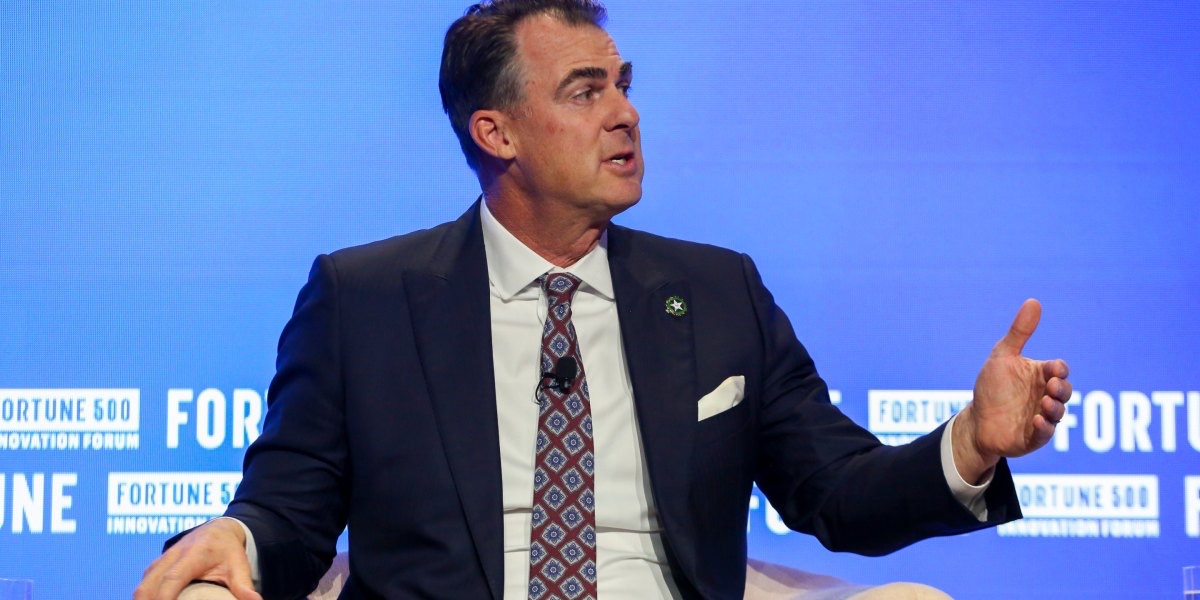
Oklahoma Gov. Kevin Stitt has a problem with the four-year degree. He brought that complaint to a room full of the people who hire its graduates.
Speaking Monday at the Fortune 500 Innovation Forum in Detroit, Stitt said the academic community is 'kind of stuck in their ways. They don't like to change.' He pointed to degree programs at the University of Oklahoma and Oklahoma State, where he said there is 'a book this thick' and then 'like three people graduating from these different things.' 'I'm not saying that degree is not important,' he added, 'but you can't be all things to all people.'
His fix is a 90-credit bachelor's degree, 30 credits short of the standard 120. That means roughly a year less of tuition. In-state tuition and fees at public four-year colleges averaged $11,950 in the 2024-25 school year, according to the College Board. Stitt says the goal is to keep the rigor, trim some electives and 'get kids ready for the workforce quicker.'
The idea is spreading. RAND counted 119 reduced-credit bachelor's programs publicly announced across the United States as of May 2026, most in applied and workforce-facing fields. Only five were announced in 2024. RAND's lead author, Jason Lee, told Fortune he has seen roughly 100 more announcements since then. That puts 2026 at about 150, though he cautioned that the newer count has not passed RAND's quality review.
Oklahoma moved quickly. Stitt signed an executive order in February calling for a 90-day study of 90-credit 'accelerated' degrees. In September, the State Regents approved four reduced-credit degrees ranging from 90 to 103 credit hours, covering social work, two programs at Oklahoma State, and workforce development at Rogers State University. 'A college degree doesn't have to take four years just because it always has,' Stitt posted on X.
Other states are following. Tennessee's higher education commission approved a policy in July allowing bachelor's degrees of as few as 90 credit hours. Texas Gov. Greg Abbott directed the state's coordinating board to develop pathways in August. The University of North Carolina system approved a pilot in April, with 11 campuses submitting proposals.
The model is not new. Much of Europe has run three-year bachelor's degrees since the Bologna reforms began in 1999. The real test is whether employers value them. Economist Michael Spence, who shared the 2001 Nobel Prize in part for showing how education works as a signal to employers, framed the question. A shorter degree is cheaper to earn. Nobody yet knows whether it signals as much.
RAND found that business, information technology and cybersecurity look most workable for shorter degrees, while clinical and licensed fields are harder to adapt. As Lee put it, 'These programs are too nascent to follow graduates into the workforce.'
The market will decide this one. If employers hire three-year graduates at comparable pay, families save a year of tuition and workers start earning sooner. That is a direct gain for the taxpayer and the student alike. If they do not, the degree will be a discount label with no buyers. Either way, the move is a reminder that a public university's monopoly on credentials is a policy choice, not a law of nature.



