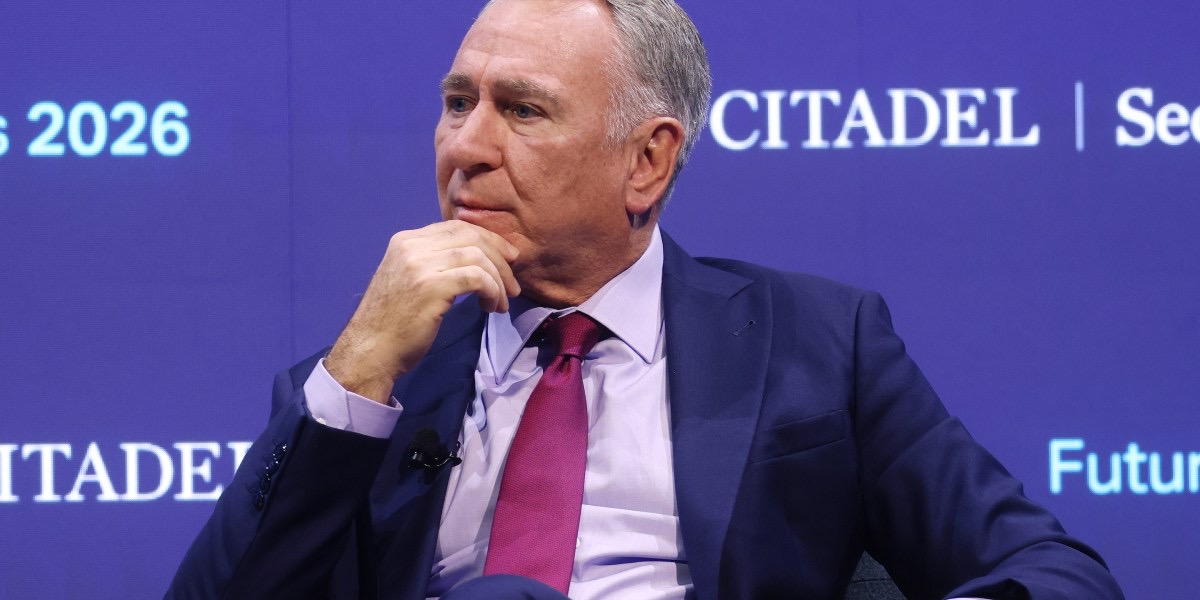
The numbers come first. Ken Griffin, founder and CEO of Citadel, is lending three rare long-necked dinosaur fossils to the Carnegie Museum of Natural History for 10 years. He is also giving $5 million to support paleontological research and education, the museum announced Wednesday.
The fossils are nicknamed Daisy, Lucky and Lucy. They belong to three plant-eating sauropods, one adult and two juveniles, found together in roughly 150-million-year-old rock in Wyoming and excavated between 2023 and 2025. According to Pittsburgh public radio station WESA, all three are Diplodocus carnegii, the same species as Dippy, the museum's most famous dinosaur. Dippy was named for founder Andrew Carnegie.
Griffin bought the fossils last year through Sotheby's for an undisclosed amount, according to the Financial Times. The deal keeps a rare find in the hands of researchers at a time when record auction prices are pushing more fossils into private collections. Many paleontologists warn that this trend could put specimens out of reach of science.
The $5 million will fund a new fossil-preparation laboratory open to public view. Visitors will be able to watch scientists free fossils from rock, a painstaking process that can take years and usually happens behind closed doors. According to WESA, the donation will also pay for two additional fossil preparers and educational programming, and will expand the museum's annual DinoFest event. Museum director Carey Miller told WESA the specimens are expected to arrive as soon as December.
The gift follows a pattern. Griffin paid $44.6 million at Sotheby's in July 2024 for a stegosaurus skeleton nicknamed Apex, then a world-record price for a dinosaur fossil. He loaned Apex to New York's American Museum of Natural History for four years. That record fell in July, when a T. rex nicknamed Gus sold for $50.1 million to an unnamed bidder. Griffin has also given $16.5 million to Chicago's Field Museum in 2017 to revamp its dinosaur exhibitions.
The larger picture is his giving overall. Griffin Catalyst, his philanthropic initiative, says his total giving exceeds $5.7 billion. On September 30, he pledged $3 billion to Carnegie Mellon University, of which $2 billion will build a new campus in Miami, where he moved Citadel's headquarters in 2022. The remaining $1 billion will support the Pittsburgh campus, including $500 million for its computer science school, now the Kenneth C. Griffin School of Computer Science.
Forbes estimates his net worth at $56.3 billion, making him the world's 33rd-richest person. He founded Citadel in 1990, a year after graduating from Harvard, and cofounded Citadel Securities in 2002.
This is what private capital can do when it is not waiting for a government grant. A fossil that might otherwise sit in an auction-house vault is now in a public museum, with a lab that lets taxpayers and families watch the work. The public gets access, the researchers get material, and no bureaucracy had to approve the terms.
The model deserves attention from policymakers who assume science depends on the state. Free enterprise built the wealth Griffin is giving away, and private donors are funding research at a scale most public budgets cannot match. The question for the next decade is whether the rules will keep that giving flowing or make it harder.



