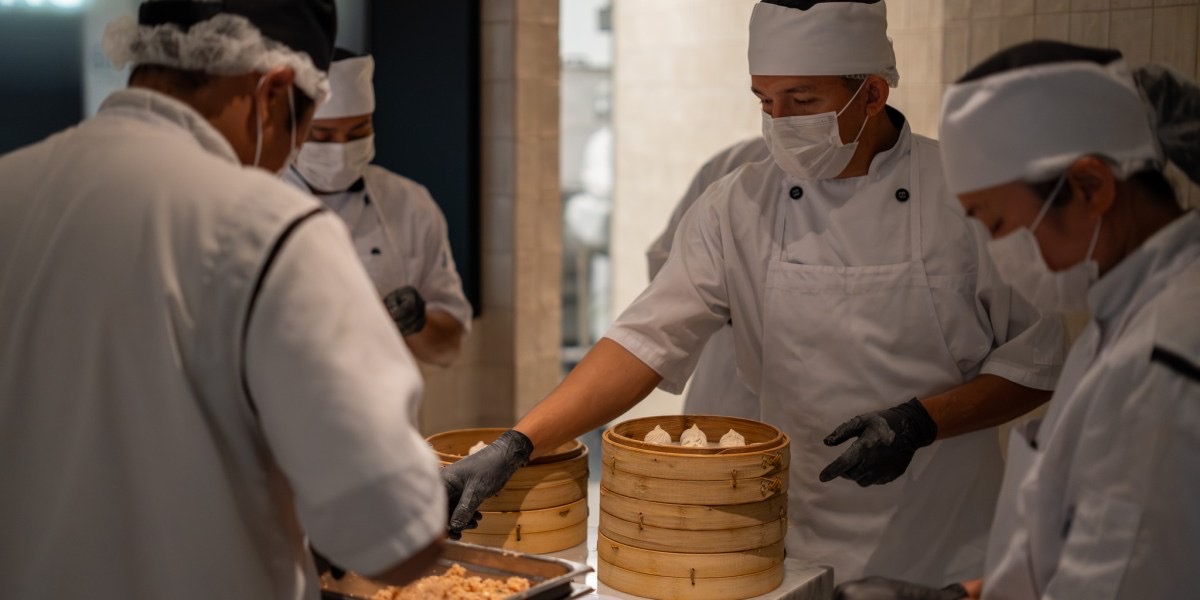
The restaurant chain with the highest per-store sales in America says its growth used to hit a wall. The wall was labor, and a very specific kind of labor. Albert Yang, CEO of Din Tai Fung North America, put it plainly to Fortune by email: 'The bottleneck used to be dumpling-folding talent. But through continuous improvements to our training programs, we've largely overcome that challenge.'
For most of the time Chinese food has been sold in America, the people folding dumplings were family. The owner, the spouse, the kids. As Lucas Sin, chef at the New York chain Junzi Kitchen, described it in a 2020 Fortune roundtable, the labor often came from 'a cousin of a cousin of a cousin from Fujian.'
Din Tai Fung has turned that craft into a corporate job track. According to Yang, speaking to the Los Angeles Times in 2023, folding now runs through a 12-week training program. Every U.S. restaurant has a dumpling training manager.
The numbers show what that system buys. Din Tai Fung's U.S. restaurants averaged $27.4 million in sales in 2024, nearly double the next-closest chain, according to Technomic data reported by Restaurant Business. Panda Express, which an engineer co-runs, now tops $6 billion a year. Peggy Cherng, an engineer by training, built the chain's own point-of-sale system in the mid-1980s. 'We had to develop it ourselves,' she said.
The old model had two engines, and both have weakened. Jennifer 8. Lee, author of The Fortune Cookie Chronicles, said in the 2020 roundtable that newcomers no longer see the trade as a path. 'But now it's pretty good in China. Why go into debt coming to America and buying a restaurant?' Foreign Policy reported in 2019 that the migrant waves from rural Fujian had slowed as conditions in China improved. Cook wages rose from about $1,500 a month in the 1980s to close to $4,000.
The family side ran out too. A 2019 New York Times analysis of Yelp data found Chinese restaurants fell from 7.3% to 6.5% of all restaurants across the 20 largest U.S. metro areas over five years, about 1,200 fewer places. Owners retired, and their college-educated children took other jobs. Jason Wang, cofounder of Xi'an Famous Foods, summed it up: 'There was no succession plan, because success was seen as not having to do it anymore.'
The survivors built around that gap. Yang traces the demand side to his own childhood. Many Americans first met Chinese food at cheap spots run by immigrants who could not afford handsome dining rooms. Now, he says, the offer has moved up. 'I hear from parents that their kids actually think it's cool when someone brings leftover Din Tai Fung to school for lunch.'
The market has already voted. Capital follows the operators who replaced craft with process early, and the pattern holds across the category.
That is the real lesson here. Family labor was never a moral failing, but it does not scale. A training program with a manager in every location, a built-in point-of-sale system and a clear career ladder does. When the labor pool thins, the businesses that survive are the ones that wrote the process down. Capital rewards clear rules, and in restaurants the clearest rule is a repeatable one.



