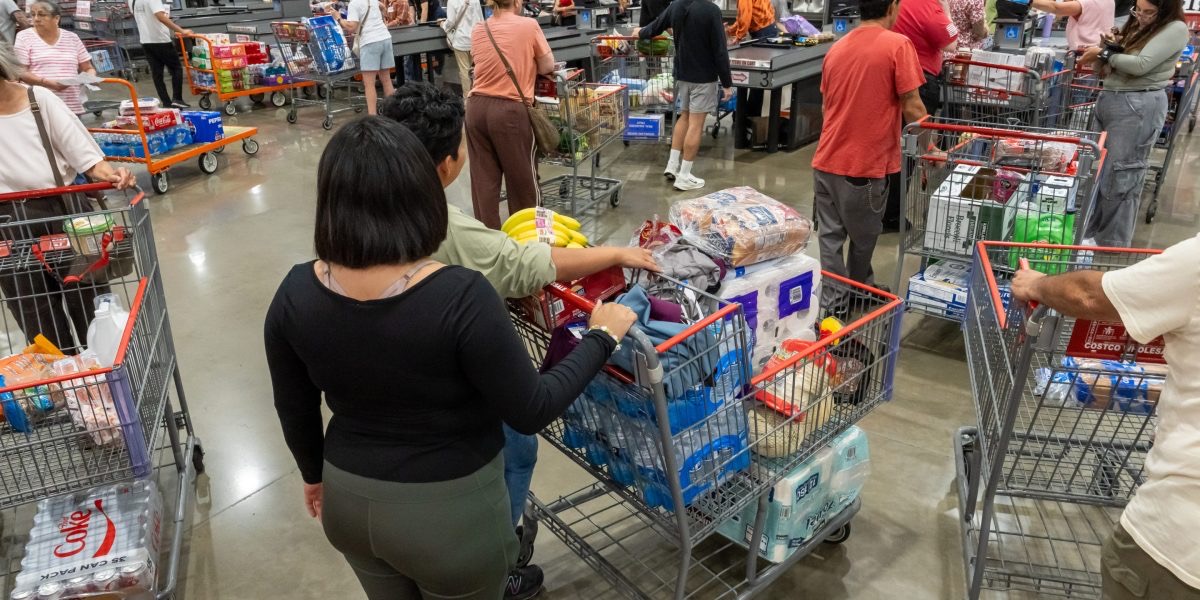
Shoppers are 'pantry-loading' again. As of Sunday night, 21 of the 26 high-ticket generators on Costco's website were sold out, according to Mizuho Securities analyst David Bellinger. One of the sold-out models, a Kohler, runs about $7,000.
The last comparable rush came in March 2020, when then-CFO Richard Galanti told investors the buying was 'off the charts' across the U.S. This time the trigger was a string of technology failures: a Microsoft Outlook outage, a nationwide FAA ground stop on November 13 that halted departures for more than four hours, and bank customers unable to move money. Bellinger told clients that consumer anxiety tied to those events, plus apocalyptic talk on social media, is behind the buying. He raised his Costco price target to $1,150 from $1,100 and said Walmart and Sam's Club could see similar lifts.
Costo CFO Gary Millerchip told Bloomberg that stronger sales of rice, canned goods, water, paper products, generators, and batteries came toward the end of October. Smaller sellers are seeing the same thing. Survival Frog, which sells emergency food, radios and other survival gear, saw sales jump 450% between October 27 and November 16 compared with prior weeks, according to founder and CEO Byron Walker, who told Axios. Most recent buyers were new customers. 'You can't turn on the news without hearing about a new cyberattack or a tech meltdown,' Walker said.
Governments added to the alarm. On October 21, CISA said critical PHP vulnerabilities required immediate patching, and PHP runs nearly 70% of websites. The next day the U.K. launched its 'Be Ready' campaign, urging families to stockpile three days of water, shelf-stable food and cash. Reports followed that the Pentagon wants every major base in the lower 48 states able to run on its own for at least 90 days. Walker credits his sales boom to exactly those warnings.
Secretary of State Marco Rubio said Wednesday there is 'zero evidence' linking the outages to one another.
The numbers have not yet fully shown up in corporate results. Costco's U.S. comparable sales excluding gas rose 8.1% in the four weeks ended November 1, the same pace as the first nine weeks of its fiscal year. Mizuho estimates growth sped up to 11% to 12% in late October and early November, with holiday shopping possibly part of that.
The market has already voted on another hedge. U.S. Mint sales of gold bullion coins fell 34% in the first 10 months of 2026 from a year earlier, and gold fell to about $3,693 an ounce, its lowest since September 2025. Households are choosing physical goods they can use over metal they can only hold.
The editorial read is straightforward. Every dollar a family spends on a generator, water filters and three days of canned food is a dollar that does not depend on a government program, a federal agency or a corporate IT department staying online. Capital rewards clear demand, and the retailers that stock what people actually need are being paid for it. The lesson for policymakers is that the most reliable emergency plan in America is still a household with its own supplies and a warehouse club that restocks them. When the state issues warnings, the free market delivers the answer.



