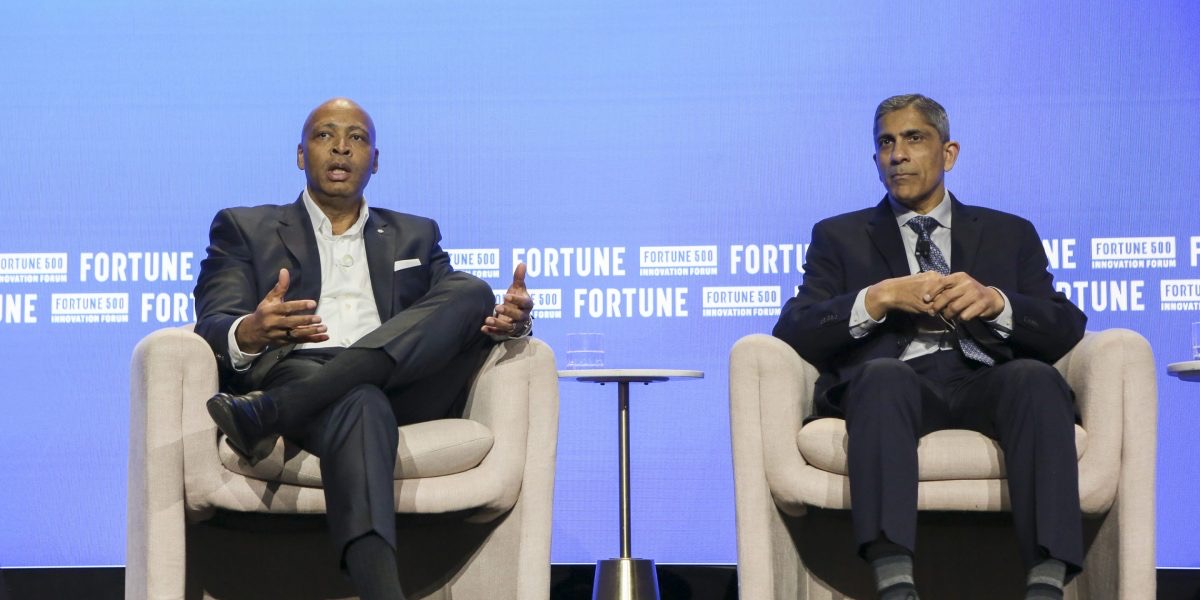
Honeywell Technologies CEO Vimal Kapur said AI is not about replacing industrial workers, but about forcing companies and employees to adapt fast as technology reshapes operations.
‘It’s about making humans more productive,’ Kapur said Monday at the Fortune 500 Innovation Forum in Detroit.
Sharing the stage with Kapur was C.H. Robinson CEO Dave Bozeman, whose logistics company said it has seen productivity gains of more than 60% since the end of 2022 as it uses AI and other technologies to automate repetitive tasks.
The two executives said AI is transforming some of America’s largest industrial companies, even as many workers worry the technology could threaten their jobs. Both told Fortune’s Andrew Nusca that AI can make workers more productive, but it also requires new skills and new ways of working.
Honeywell has spent the past two years reshaping its own business. The company spun off its advanced materials business and aerospace division to focus on industrial automation. Kapur said AI is now part of that same effort.
While much of the public attention has centered on AI-powered humanoid robots and their potential to replace factory workers, Kapur said the bigger opportunity is to help employees do their jobs more effectively. He argued AI could be especially useful for companies struggling to find enough skilled industrial workers in hands-on roles.
Rather than replace those workers, he said, AI can supplement their expertise and help them handle tasks that may require more specialized training.
But, Kapur added, the change goes beyond installing software. Businesses have to redefine entire processes and make sure employees have the skills to do the work.
‘Next 18 to 24 months, we all have to reskill ourselves. And we take it very seriously because it’s not a small change for myself or for the entire organization,’ he said.
At C.H. Robinson, Bozeman said the company is using AI agents to take over tasks that once required employees to manually review millions of transactions. In its ‘order-to-cash’ process, which includes customer orders, freight quotes, shipment orders, and pickup and delivery scheduling, the company has built specialized AI agents rather than relying on a one-size-fits-all system.
Bozeman said that has allowed employees to spend less time on repetitive administrative work and more time solving complicated supply-chain problems for customers.
The company is also preparing for a major acquisition. In October, C.H. Robinson said it was buying rival freight broker RXO for $5.8 billion. The deal is expected to close in the first quarter of 2027.
C.H. Robinson said it expects about $300 million in annualized cost savings within two years of the deal closing, partly through its AI-powered operating model, Lean AI.
Kapur said he heard similar fears in the 1980s, when some warned computers would replace engineers. Instead, he said, the technology changed how engineers worked without eliminating the profession.
For Kapur, the lesson is simple: executives cannot ask workers to adapt unless they do the same. He said he personally took training on Copilot, arguing leaders need to learn the tools before they tell others how they work.
The numbers come first. In this case, AI is not just a story about software; it is a story about margins, productivity, and the ability of free enterprise to reassign labor toward higher-value work. When companies can automate the mundane and force management to reskill, capital tends to reward the operators that move first.
The market has already voted on that logic. The real question now is whether workers get new leverage from these tools, or whether bureaucracy and fear slow down the gains that better processes can deliver.



