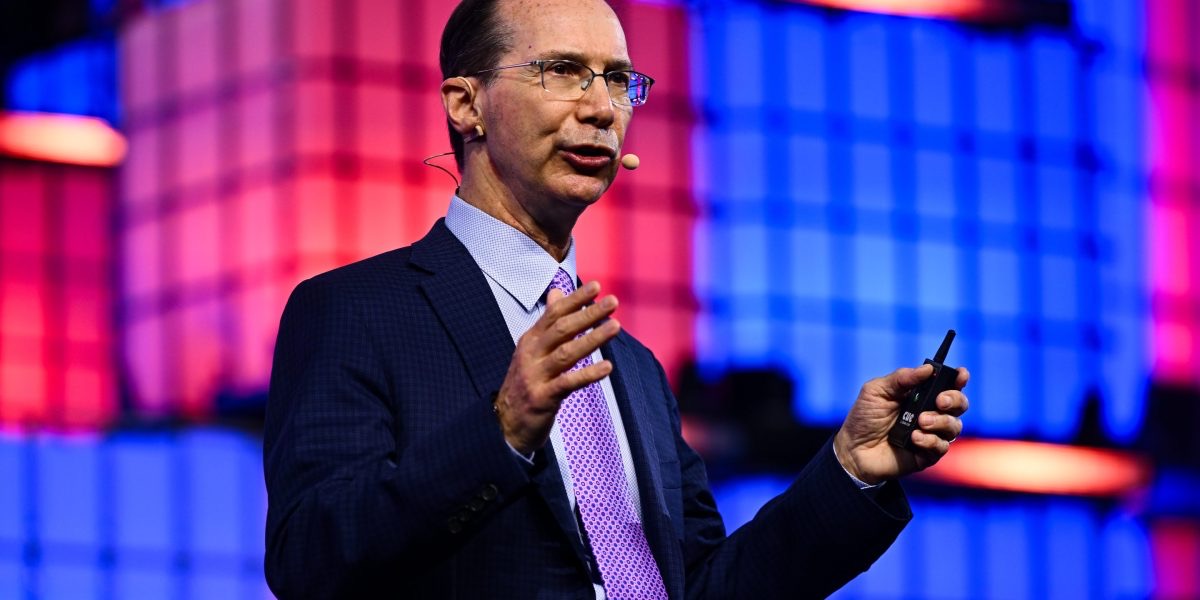
Bill Gross says artificial intelligence could reshape the American labor force into something closer to China’s army of one-man companies.
The founder of Idealab says that vision could be a way to create 30 million one-person companies in the United States, with AI acting as a 'leveling tool' for income and wealth.
Gross made the case while speaking on the sidelines of the Web Summit conference in Lisbon. He said a surge in small businesses could help with taxation, income equality and the national debt.
'I had this dream of making a million companies,' Gross said. 'I think we could have 30 million one-person companies in the United States, and if you had 30 million one-person companies, that would really do a lot for taxation. That would do a lot for income equality, and that would do a lot for not having people near the bottom worried about where they stand relative to the people at the top.'
Gross added that AI could be used as a 'leveling tool' and said he hoped there could be '30 million companies that are very small but all very profitable.'
He said that together those firms could be larger than the biggest company, while distributing wealth to more people. He also said using AI this way is 'democratizing it' and could cause more equality.
Gross is the founder of Idealab, one of the longest-running tech incubators, launched in 1996. Fortune said it has 45 IPOs and acquisitions to its credit. Gross made his fortune building software and later launched Idealab Studio, an AI-powered platform that provides startup ideas, support and investment.
Idealab Studio is based in Pasadena, California, and Fortune says it is a database of 1.2 million AI-generated business ideas. Gross said the ideas are free, and users only contact the company if they want funding or want to work with its tools.
He said the same idea can be used by multiple people, and that is not a problem because they can adapt it to different markets.
The backdrop is stark. Fortune cited Fed data saying the top 1% of households in America own more than 50% of the stock market. Of the $64.4 trillion sum that makes up corporate assets and mutual funds, a little over $16 trillion is owned by the top 0.01% alone.
Gross is betting that AI can widen access to capital and lower the barriers to entry for free enterprise. In a country where business starts remain near all-time highs, the question is whether technology will spread ownership or simply concentrate leverage in the hands already holding it.
Gross is trying to answer that with an open-door model: free ideas, small firms, and a lot more people taking a shot at the market. If he is right, the winners will be entrepreneurs and taxpayers. If he is wrong, the administrative state will still be left managing the fallout from a labor market that changes faster than Washington does.



