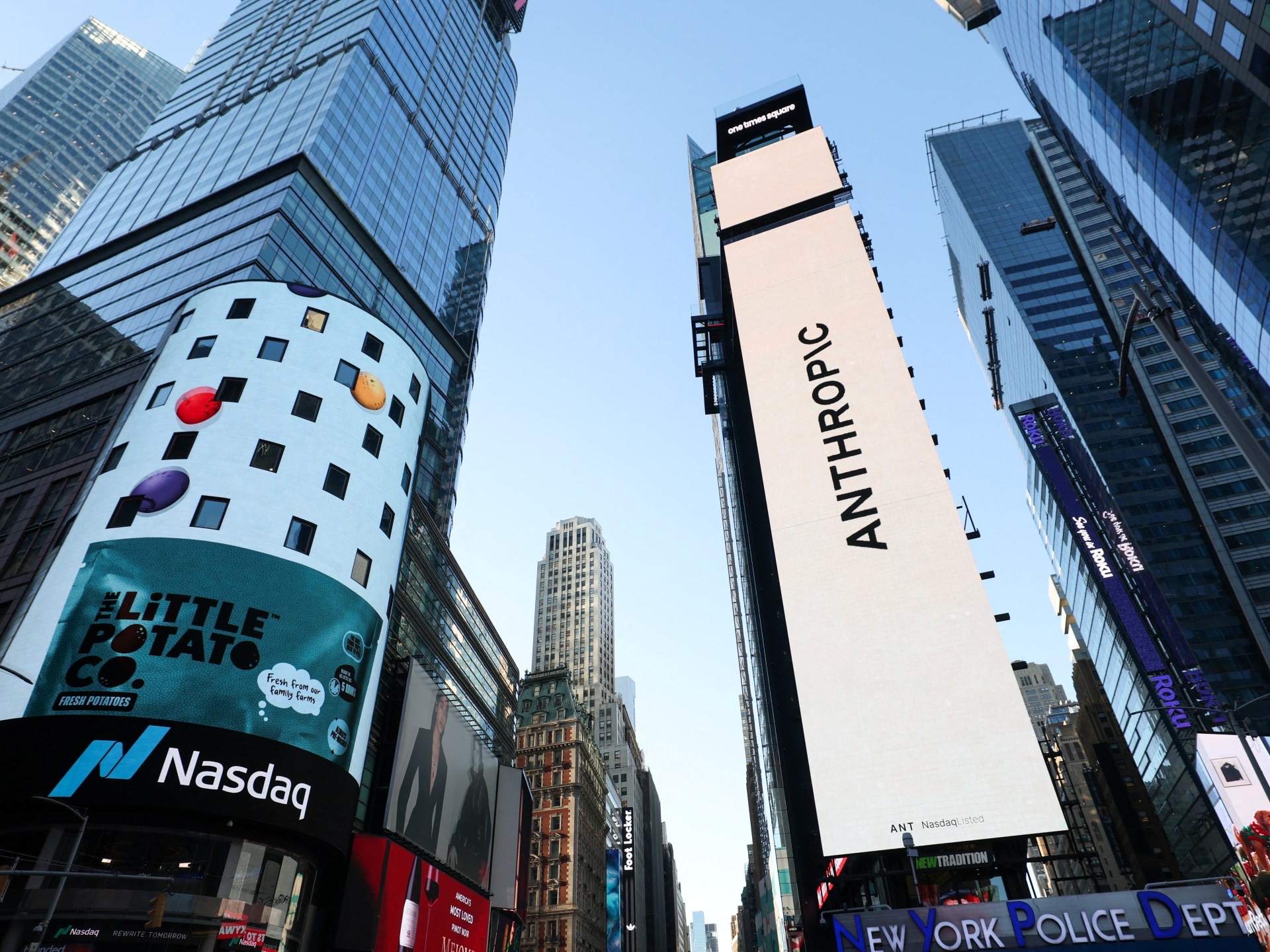
The numbers come first. Anthropic, the maker of the Claude AI assistant, began trading on the Nasdaq on Thursday, November 19, under the ticker ANT. The offering raised $81.3 billion, making it the largest initial public offering in history by deal size and surpassing the debut of Elon Musk's SpaceX. The company had valued itself at $2 trillion before pricing.
The deal was repriced on the eve of listing. Anthropic had initially said it would offer 825 million shares at a range of $70 to $78. On Wednesday it announced it would sell 980 million shares at $83 each. The stock opened at $111.50, a 34 percent gain over the offer price, dipped below $100 in midday trading, and closed at $97.17, still nearly 17 percent above the IPO price. The broader market was weaker that day. The Nasdaq fell 2.2 percent, the Dow Jones Industrial Average fell 2.19 percent and the S&P 500 fell 1.8 percent. Nvidia dropped 3.3 percent, Meta 3.2 percent and Advanced Micro Devices 7.72 percent.
The market has already voted on the appetite for AI exposure, but the bankers were the first to be paid. According to Fortune, citing Anthropic's prospectus and a source familiar with the matter, Goldman Sachs and Morgan Stanley each collected $113 million, because each took on underwriting commitments of 20.5 percent of the offering. Fortune estimates JPMorgan and Citigroup at roughly $55 million apiece, and Bank of America at about $16.5 million. The total fee pool of at least $550 million eclipsed the roughly $500 million earned on SpaceX's June debut. Matt Kennedy of Renaissance Capital told Fortune that mega IPOs like Anthropic 'have done a lot of the heavy lifting' to make 2026 a standout year for investment banks.
The filing also tells a harder story. According to Al Jazeera and Reuters, Anthropic disclosed a net loss of $104 billion in the first nine months of 2026. Roughly 90 of the more than 300 pages were devoted to risks, including warnings that its AI systems could pose 'catastrophic or existential risks to humanity.' Dan Ives of Yorkville Ives called the listing 'a big near-term win for the tech sector,' while IPOX's Lukas Muehlbauer warned that some demand may reflect investors not wanting to miss a rare chance to own a leading AI company, 'even if its long-term profitability remains uncertain.'
Political pressure is building as well. Al Jazeera reports backlash from voters in the recent midterm elections, where all but one ballot initiative restricted the expansion of data centers, and a Democratic sweep on platforms of reining in the AI industry. A coalition of AI safety experts issued the 'Misanthropic Statement,' which argued that 'Anthropic is not a safe AI company.' Anthropic responded that it would 'pace the training and deployment of AI systems' and would 'not bend to either business or political pressure,' according to a statement quoted by Al Jazeera.
For the free enterprise reader, the lesson is clear. Capital rewards companies that can scale and that investors believe will earn returns, and the public markets just priced a $2 trillion valuation into a company with a deeply negative bottom line. Investors and the taxpayer alike should note that the listing is a test of whether shareholders, not regulators or lawmakers, will discipline this sector. The market has put its money down. The question now is whether the risk disclosures in that 300-page filing will be read as carefully as the fee tables.



